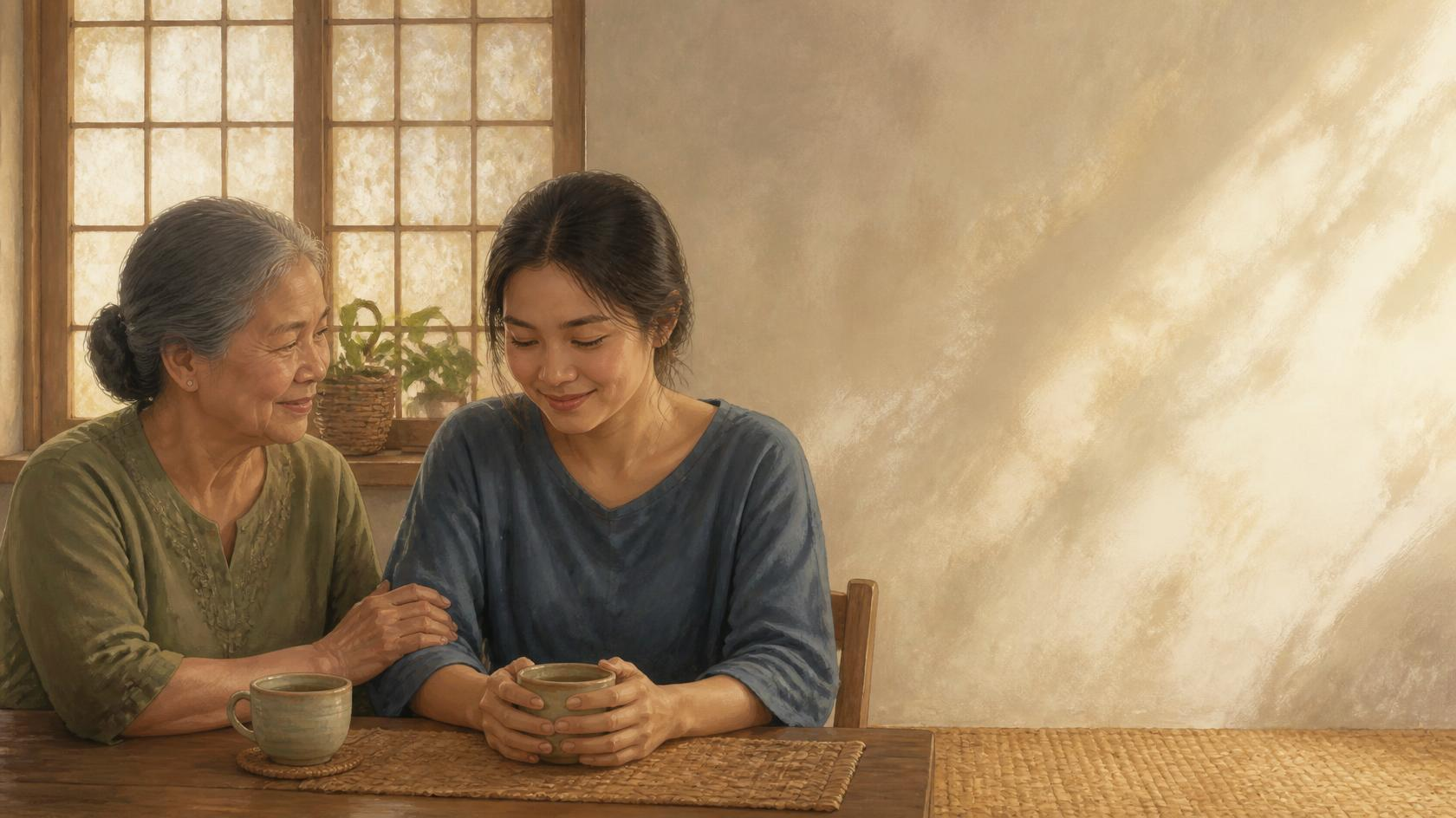
Have you ever held back from speaking up? Not from shyness, but from a deep worry about what others might think of you, or of your family? For many Filipinos, that feeling has a name: hiya.
As a Filipino psychologist in Wahroonga, I often see how hiya can quietly keep people from getting support. In this post, I explain what hiya really is, how it can affect mental health, and culturally grounded ways to move towards healing.
At a glance
- Hiya is often translated as “shame”. It’s closer to a sense of propriety: knowing how to act with care around others.
- Hiya helps hold families together. It can also keep people silent when they’re struggling.
- Asking for help can be an act of kapwa: care for yourself and the people you love.
Filipino words in this article:
- Hiya · propriety, shame
- Kapwa · shared self
- Pamilya · family
- Barkada · friend group
- Mukha · face
- Pagtitiis · endurance
- Pakikiramdam · sensing others’ feelings
- Pakikipagkuwentuhan · heartfelt storytelling
Hiya is more than shyness
Western ideas of shame often focus on personal failure. Hiya is more relational. It lives in our connections with family, barkada and community.
Virgilio Enriquez, the founder of Sikolohiyang Pilipino (Filipino Psychology), argued that hiya is better understood as a sense of propriety, not simply shame.[1]
- Protecting pamilya. We can feel hiya on behalf of our whole family. That brings pressure to avoid anything that might “bring shame” to the family name.
- Caring for kapwa. Hiya is tied to kapwa, the shared self that connects us. Breaking social norms can feel like a tear in that connection.
- Deference and respect. Hiya can look like politeness. We may not disagree with elders, teachers or people in authority, even when something feels wrong.
When hiya helps
It builds respect, harmony and care for other people’s feelings. It keeps families and communities close.
When hiya weighs heavy
It can silence honest feelings, hide struggles, and make asking for help feel impossible.
The hidden weight of hiya on mental health
Research with Filipinos in the Philippines and overseas shows a clear pattern. Stigma, worry about losing face, and a sense of shame are major barriers to seeking help. Many people turn to family and friends first, and see a professional only as a last resort.[2][3]
Silence and stigma
Fear of hiya can stop people admitting they’re struggling with anxiety, low mood or stress. Help can feel like weakness, or an embarrassment for the family.
Waiting too long
Talking to an “outsider” about family matters can feel like a breach of privacy. So people often wait until things are very hard.
Carrying it alone
Keeping mukha (face) and showing pagtitiis can mean pushing feelings down. Stress may then show up in the body, as headaches, poor sleep or tiredness.
Misreading what’s going on
Struggles may be seen as moodiness, weakness, or something to pray through. Faith can be a real comfort. Mental health support can sit alongside it.
Hiya and neurodivergence
For ADHD and autistic Filipinos, hiya can add another layer. Many learn to mask: hiding their traits to fit in and avoid bringing shame. Over time, masking can be exhausting. Read more in More Than Pasaway: ADHD through a Filipino lens.
Paths to healing that honour our culture
Healing from hiya doesn’t mean leaving your culture behind. It means letting your values care for you, too.
- Redefine strength. Pagtitiis is a real strength. So is saying “I’m not okay” and asking for support.
- Try pakikipagkuwentuhan. Start with one safe person: a trusted relative, friend or faith leader. Being heard with kindness can lift a heavy load.
- Remember the kapwa of compassion. Kapwa is about care, not only fitting in. When you’re well, your whole family benefits.
- See professional help as empowerment. Therapy is confidential. It’s a space to understand hiya, not to be judged for it.
Gentle questions to sit with
- Whose voice do I hear when I feel hiya?
- What would I say to a friend carrying what I’m carrying?
- Who is one safe person I could talk to this week?
How Psychcare can help
- A Filipino psychologist who understands. I know hiya, kapwa and family expectations from the inside, so you don’t have to explain everything. Meet MJ.
- Confidential, non-judgmental therapy. We use approaches such as CBT, ACT and EMDR therapy, shaped around your culture and values. Learn more about our therapy and support.
- Room for family. Where it helps, we can include parents or other family members to build shared understanding.
- Neuro-affirming care. If you wonder whether ADHD or autism is part of your story, see our ADHD & Autism Assessments.
Sessions are available at our Wahroonga clinic or by telehealth anywhere in Australia. You may be able to claim a Medicare rebate with a Mental Health Treatment Plan from your GP.
More support for Filipino and multicultural communities
In NSW
The Transcultural Mental Health Line on 1800 648 911 offers free, confidential phone support for people from culturally and linguistically diverse backgrounds. It runs 9am to 4:30pm, Monday to Friday.[4]
Australia-wide
Embrace Multicultural Mental Health, run by Mental Health Australia, shares translated mental health information and links to services.[5] Visit embracementalhealth.org.au.
Keep reading
Ready to take the first step?
You don’t have to carry hiya alone. Book online, call us, or start with a free, confidential 15-minute chat.
(02) 9037 3509Suite 4 & 5, 5 Redleaf Avenue, Wahroonga NSW 2076. Telehealth Australia-wide. Psychcare is not an emergency service. If you or someone you know is in immediate danger, call 000 or contact Lifeline on 13 11 14.
Sources
- Pe-Pua, R., & Protacio-Marcelino, E. (2000). Sikolohiyang Pilipino (Filipino psychology): A legacy of Virgilio G. Enriquez. Asian Journal of Social Psychology, 3(1).
- Tuliao, A. P. (2014). Mental health help seeking among Filipinos: a review of the literature. Asia Pacific Journal of Counselling and Psychotherapy, 5(2).
- Martinez, A. B., et al. (2020). Filipino help-seeking for mental health problems and associated barriers and facilitators: a systematic review. Social Psychiatry and Psychiatric Epidemiology.
- NSW Government. Transcultural Mental Health Line.
- Mental Health Australia. Embrace Multicultural Mental Health.
This article is general information, not personal clinical advice.